



- Your payslip contains a range of important information. It summarises what you earn and what’s deducted (including Income Tax, National Insurance (NI), your tax code and your pension contributions).
- Understanding your payslip helps you plan your finances, claim benefits accurately, and spot any errors that need to be rectified.
- Every employee in the UK is legally entitled to their own itemised, written payslip. This includes casual staff, but not contractors or freelancers.
Your payslip explained
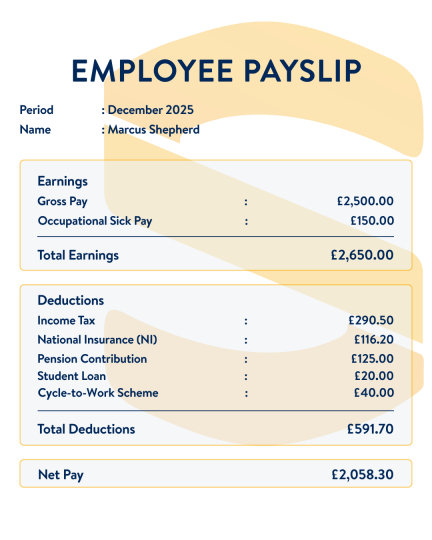
Your payslip should always include the following information. Use the diagram above to help you work out where to find everything on your payslip.
| Item | What it means | Example | Why it matters |
| Gross pay | The total amount earned before any deductions (includes salary, overtime and bonuses). | £2,500 per month (before tax). | Helps you check your total contracted pay. |
| Net pay | This is your take-home pay after tax and other deductions. | £2,000 (after deductions). | Shows how much you actually receive, so you can plan your finances accurately. |
| PAYE | This stands for Pay As You Earn. It’s a system employers use to collect Income Tax and National Insurance for HMRC. | £300 Income Tax deduction. | Ensures your tax and NI are paid automatically. |
| OSP | Occupational Sick Pay – sick pay your employer may pay on top of Statutory Sick Pay (SSP). | £150 OSP payment while off sick. | Offers you additional income alongside SSP during illness. |
There are some other deductions that should appear on your payslip, however some of the below may not apply to you:
| Deduction Type | What it means | Mandatory or Optional | Example |
| National Insurance (NI) | Contributions towards state benefits and pension. | Mandatory, if applicable | National Insurance Rates. |
| Pension | Contribution to your workplace pension scheme. | Usually mandatory | 5% employee contribution. |
| Student Loan | Repayment of your student loans, based on income threshold. | Mandatory, if applicable | 9% on income above threshold. |
| Court Orders / Child Maintenance | Legal deductions from your wages. | Mandatory, if applicable (court-ordered) | £100 monthly deduction. |
| Salary Sacrifice / Benefits | Optional deductions for schemes like cycle-to-work or other benefits offered by your employer, such as season tickets for public transport. | Optional | £40 per month bike scheme payment. |
How can you read and interpret your payslip effectively?
Here’s an easy step-by-step guide to help you check your payslip:
| Step | What to check | Why it matters |
| 1 | Make sure that your name, NI number, and payroll ID are all correct. | This helps to make sure you have received the payslip that belongs to you and that all of the details are accurate. |
| 2 | That your gross pay matches your agreed salary or hours | Confirms that you have received the correct amount of pay. |
| 3 | Tax code accuracy | Prevents over or underpayment to HMRC. |
| 4 | Deductions listed correctly | Offers transparency and a full breakdown of any deductions. |
| 5 | Net pay matches expected take-home pay | Means you can spot any errors quickly and ask your employer to rectify them. |
| 6 | Keep payslips safely | You’ll need to hang on to your payslips for loans, mortgages, and your records. |
Key points to remember
Understanding your payslip helps you manage your income with confidence. Whether you’ve been working for your employer for 6 months or 6 years, it’s always worthwhile to pay close attention to your payslip and the important information it contains. Double check every payslip to make sure that everything is correct and keep them safe for future reference.
For helpful tools and guidance on how to make the most of your money, our Resources hub is full of free guides and articles. If you’d like to learn about protecting your earnings, visit our Income Protection page.
No advice has been given by Shepherds Friendly. Should you have any concerns about the information contained on your payslip then there are free advice organisations that may be able to provide assistance, such Citizens Advice Bureau